
“When you settle into a rhythm, it feels like flying,” INWA Nordic walking instructor Katie Atkins tells me. “Even when you see people out walking nowadays, they’re on their phones. But Nordic walking is a technology detox. You can’t hold a phone because you have a pole in each hand. For the time you’re walking, you have the chance to just be; to chat and to enjoy what’s around you.”
Millions of people across Europe use Nordic walking to keep themselves in shape. The UK has been slower to adopt the activity, particularly among younger people, but Nordic4 founder Atkins says we’re missing out on benefits both above and below the neck.
This low-impact pastime puts upwards of 80 per cent of your muscles to work – far more than regular walking. Research suggests it also burns considerably more calories, holds greater heart health perks, does a better job of boosting fitness and offers greater protection against many chronic diseases than a standard stroll.
“I played a lot of tennis before, and I found the right side of my body was much stronger and more coordinated than the left side,” Atkins adds. “The thing I’ve really noticed in the last 16 years of Nordic walking is it’s really good for balancing the body up.”
A healthier, fitter and more balanced body is an attractive prospect. So is the idea you can build one with an accessible, social and enjoyable form of exercise.
If this pitch has sold you on the idea of Nordic walking, here’s is how to get started.
How to start Nordic walking
Nordic walking is more than just walking with poles, as the video above explains. There needs to be a considerable focus on technique when you first start.
The first step is to practice walking with an upright posture and a natural arm swing. Next, you need a set of walking poles with straps.
“The straps are really important,” Atkins says. “They enable you to propel yourself forward, then extend your arm and release your grip, before catching the pole again as your arm swings forward. People talk about sculpted ‘Nordic arms’ because you’re working your triceps with every step.”
One common beginner mistake is holding the poles upright. Instead, they should remain at roughly a 45-degree angle, allowing you to push the ground away and propel yourself forward each time yours arms swing backwards.
“You also want to be looking ahead, strike the ground with your heel first and have good postural alignment with a slight forward lean from the ankles – like you get in cross country skiing,” Atkins adds. “That activates your glutes, then your arms and core are engaged as you push through the pole, and your legs are working too.
“Used correctly, the poles enhance your walk. As you push through them, you actually feel the load on your knees and hips lighten. It’s lower impact than activities like running.”
For this reason, she says it is suitable for everyone from Olympic athletes seeking improved performance to those over 60 or looking to rehab an injury.
You can follow the advice above to get a good grounding in Nordic walking. However, much of the appeal and many of the perks come from doing it as a group. Instructor-led sessions are also the best way to fine-tune your technique, Atkins says, with many groups offering taster sessions.
You can find your nearest INWA (International Nordic Walking Federation) certified group on the British Nordic Walking interactive map.
Read more: How just 20 minutes of walking a day can transform your health
 Nordic walking can imrpove health and fitness in people of all ages and ability levels, instructor Katie Atkins says (Credit: International Nordic Walking Federation) (International Nordic Walking Federation (INWA))
A sample Nordic walking session for beginners
Neil Yoxall, an experienced hiker and sales manager for outdoor equipment specialists Silva, suggests the session below for anyone looking to get a feel for Nordic walking.
Start with a five-minute warm-up walk at a relaxed pace, don’t worry too much about speed. Spend 15-20 minutes Nordic walking at a pace comfortable to you, focusing on technique and rhythm. Every five minutes, spend 30 seconds exaggerating the push through the poles to feel the extra upper-body engagement. Finish with a five-minute cool-down walk and some gentle mobility stretches using the poles.
“When you first try, it’s more important to build confidence in the movement than to chase distance or intensity,” he explains. “Once your technique feels natural, you can gradually increase either the duration, pace or the types of terrain you’re covering.”
Read more: Scientists share six easy ways to increase the health benefits of your daily walk
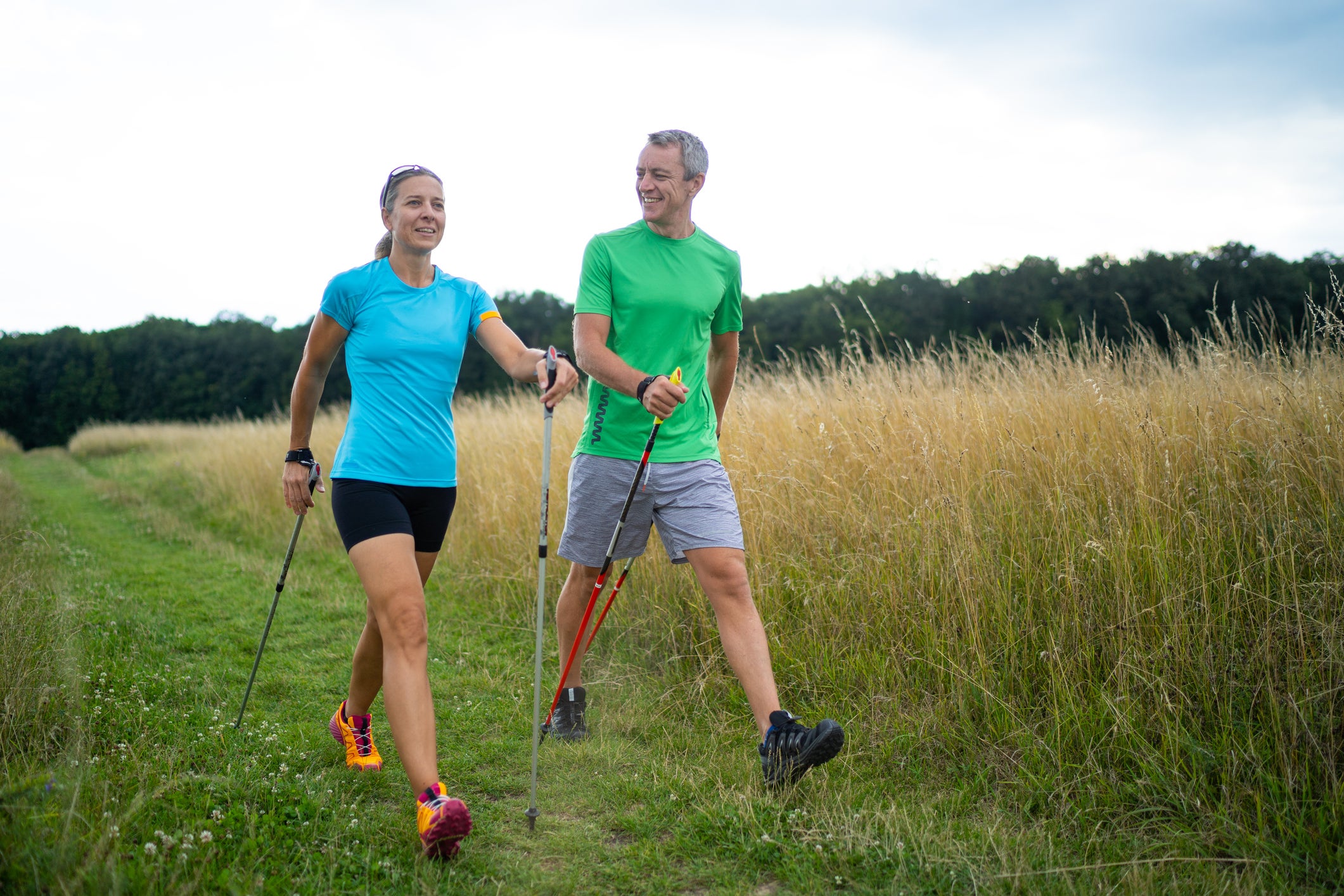 Nordic walking boosts physical and mental health while providing a social hit (Getty/iStock)
The benefits
“The poles effectively turn walking into a coordinated whole-body movement,” says Yoxall. “Every time you plant a pole and push backwards, you’re generating force through the upper body while maintaining a natural walking gait. This extra muscular involvement increases the overall work your body is doing and encourages an upright posture.
“At the same time, some of the impact and effort that would normally be absorbed solely by the lower body is distributed through the arms and shoulders.”
The lower impact nature of Nordic walking is one of its major pull factors. This is partly because there is a well-worn path for amateur athletes.
Team sports tend to dominate their teens and twenties, solo endurance endeavours such as running take over in their thirties, then joint pain sees them switch to cycling and swimming in their 40s and beyond. With busy lives and injuries, participation often tails off over time.
But, Atkins argues, Nordic walking is an activity that can serve you through every season of life.
“When you go to mainland Europe, people very much see Nordic walking as a sport – you see it everywhere and it’s part of their way of life,” she says. “It’s regarded as an activity that Olympic athletes can use to train. They’re a bit ahead of the game compared to where we are in the UK. Here, it’s often seen as an activity for older people and middle-aged women, but that is changing now, which is exciting to see.
“You can Nordic walk from childhood right up to old age, building physical literacy for life.”
Read more: The easiest way to strengthen your entire body, according to this expert coach
 The use of poles can take stress away from the hip, knee and ankle joints, delivering a lower impact form of cardiovascular exercise than running (iMarzi – stock.adobe.com)
Nordic walking also takes place outside, delivering the many well-documented mental and physical health benefits that come with getting out of the house and into nature. And it puts you in a group setting.
“Nordic walking is an opportunity to connect with other people, and with nature,” says Atkins. “There’s nothing like seeing the seasons change and really noticing everything around you. It also gives you the opportunity to explore different terrain, which you might not feel comfortable doing on your own.”
There is a learning element involved too, with adopting new skills being one of the best things you can do to maintain a healthy brain, according to Harvard Health. Atkins likens an introduction to Nordic walking to learning to drive.
“When you start, you have to think about checking your mirrors, using your indicators and performing certain manoeuvres. Then, with practice, it all goes into muscle memory.”
Learning to coordinate her body in this way helped Atkins strengthen her body and swerve injuries, despite having hypermobility.
“The poles keep me aligned, allowing my muscles and joints to become stronger” she says. “Everything is being used in the way it should be used, rather than being very loose. I think, without Nordic walking, I would otherwise have had problems in my joints.”
.jpeg) People competing in a Nordic walking race (International Nordic Walking Federation (INWA))
People competing in a Nordic walking race (International Nordic Walking Federation (INWA))
The best poles to buy
The most important thing when finding the best walking poles is to find a set built specifically for Nordic walking, with a strap attached to the handle, Atkins says. She favours Leki poles, while brands such as Silva, Exel and Gabel also offer good options from around £50. A price point of £80-£90 often offers the best balance between quality and value, Atkins adds.
Beyond this, there is a great deal of personal preference at play, as well as several individual factors to consider.
“It’s all related to your height and proportions,” Atkins explains. “You might have someone who is 5ft 4in, so you assume they need a specific pole height, but they could have a very short upper body and very long legs. That’s why I’d recommend going to a retailer who can advise you properly.”
A strong, lightweight pole is preferable, as this will deliver durability and a more enjoyable walking experience. A higher carbon content tends to deliver on both fronts, Atkins says. If you plan to use your poles while travelling, a pair that can collapse into segments and be packed away can also be handy.
Read more: Do this for three months and transform your fitness for years
.jpeg) Members of a Nordic walking class using the poles to stretch and improve mobility (International Nordic Walking Federation) (International Nordic Walking Federation (INWA))
Members of a Nordic walking class using the poles to stretch and improve mobility (International Nordic Walking Federation) (International Nordic Walking Federation (INWA))
Other ways to strengthen your body through Nordic walking
There are few areas of the body that aren’t active while Nordic walking. But there are extra exercises you can do with the poles to build further strength, mobility and balance.
These range from standard exercises like overhead presses, pole-supported lunges and squats – planting a pole in the ground to hold on to for support – to more novel movements.
“There’s one exercise that I call crackers,” says Atkins. “You hold the pole out in front of you with your arms parallel to the ground and your hands shoulder-width apart. Then the hands stay still, but you try to pull the pole apart like a cracker for five to 20 seconds, strengthening the upper body.
“Or you can do the reverse cracker, holding the pole in the same way but trying to squeeze your hands together, filling in other parts of the upper body. It feels great.”
“Walking poles can double as a simple fitness tool,” adds Yoxall. “Before or after a walk, you can use them for mobility exercises such as torso rotations, chest-opening stretches and shoulder mobility drills. They can also be incorporated into balance exercises, supported squats, lunges and calf stretches.”
Read more: You don’t need to lift weights for strength training – these exercises count too